Depth of Field — Part 2: The Grand Landscape
The other side of mastering depth of field is photographing the grand landscape. In part 1 I talked about photographing a portrait where you will need both the appropriate f-stop and subject. The correct f-stop will allow only your subject to be in focus and the correct subject will have enough distance between it and the background to allow an out of focus, poster board, background. When you are photographing a landscape chances are that you will want the entire picture to be in focus. The extreme circumstance of this is when you are using a wide-angle lens and your composition goes from a foreground clump of flowers 18″ away to a mountain range at infinity focus. The question I am always asked on my workshops is where do you focus when do a shot like this? If you focus too far away your foreground will be blurry but if you focus too closely your background will be blurry. In the old days we used to call this hyperfocusing. Hyperfocusing is a technique of maximising your focus so that your image will have the greatest depth of field for whatever f-stop used. When you hyperfocus you are picking a point of focus which will allow the depth of field to reach both the closest and farthest points in your composition. This is not an easy thing to do and it is nearly impossible to estimate without some aid. Used to be a time when camera lens actually had very useful little hyperfocusing scales on them that were accurate, easy to use and very handy. Not wanting to make photography too user friendly most lens makers did away with these little scales leaving us a bit high and dry. Then little charts started to appear that listed every possible f-stop and distance combination and then apparently told you where to set your focus. The problems with these charts is that I never really figured them out, I never had them with me when I needed them and I never had a tape measure with me to measure my composition. Then some cameras came out with a depth of field program that automatically set the focus properly. My problem with these is that first I don’t trust them and second I don’t trust them. Remember: autoexposure, autofocus, oughtoknowbetter! So what is a photographer to do? There are two, low-tech techniques. The first one assumes that a majority of the time when you are thinking about hyperfocusing you are using a wide-angle lens (typically between 20mm and 35mm), you are using your smallest f-stop (usually f-22 or f32), the closest point in your composition is less than 3’ away and your camera is angled down. (You may not be angling your camera down to do your grand, sweeping landscapes but you should be. When you do so you draw in the foreground and make your composition much more compelling and inviting.) When this is the case simply focus in the center of your viewfinder. That point will almost always be 4′ to 6′ away from you. I could make this more difficult but it really is that easy- focus in the center of your viewfinder. If for some reason you are not doing your sweeping landscapes with a wide-angle lens, small f-stops, interesting foregrounds and downward angled cameras you need to avoid wide open spaces or not take your camera with you anytime it is light out. Sorry, you needed to know. If you want to be sure of this focus point or if you are distrustful of really easy, helpful techniques you can double check your focusing point by multiplying the distance to the closest point in your composition by two or three. This is John Shaw’s technique. If the closest point of his shot is 2′ away he will focus 4′ to 6′ away. He then fine-tunes the focus by using his depth of field preview button. When you do this you will notice that you have focused in the center of your viewfinder. There you have it, two easy ways to solve your hyperfocusing problems. Now return your tape measure to your junk drawer and put all those silly cards away with all those other silly photography cards you have accumulated over the years and go out and take some pictures.
Depth of Field — Part 1: The Grand Portrait
Depth of field is one of the foundation concepts in photography and yet it is one that many of my students still don’t quite understand. Well, they think they understand it and they mostly do but the practical implications of using depth of field are almost universally poorly executed. Everybody knows that depth of field refers to the amount of the final image that is in focus. To simplify, a shallow depth of field means that there is very little of the final image that is in focus; a lot of depth of field means most of the image is in focus. Everybody also knows that the physical size of the aperture -the f-stop- determines the resulting depth of field. A small-numbered f-stop – f2.8 or f4.0- means a large aperture and very little depth of field. A large-numbered f-stop –f16 or f22- means a small aperture and a lot of depth of field. This is the basic stuff. Once you understand the seemingly reversed relationship that a small aperture equals a large amount of your image will be in focus and that a large aperture equals a small amount of your image will be in focus you pretty much understand the basics of depth of field. Ah, but there is more! Understanding the concept and putting it to use are two different things. The f-stop you choose is not the sole determinate of how much of your image will be in focus. The other key component that effects the final appearance is the distance the subject is from the background. This is especially true when doing any kind of portraiture be it of a flower, an elk or a grandchild. If the background is too close it will always be annoyingly in focus no matter what f-stop you use. I see this all the time while doing critiques in the workshops I teach. Someone will show an image of a portrait they tried to do. They wanted a nice sharp subject and a completely out of focus background (what is known as a poster board background). Almost always either the subject is fine but the background is not out of focus enough or the background is wonderfully out of focus but the subject is not in focus enough. Ideally, you want either everything in your image to be in focus or just your subject in focus and everything else way out of focus. If something obvious is not quite in focus it will likely be a major distraction. This is because the mind tries to resolve slightly blurry things thus making it distracting. If something is way out of focus the mind accepts it as unable to be resolved and ignores it. So what is one to do? In order to get a beautiful poster board background for your wildlife, wildflower or wild-child portrait the f-stop you choose is not nearly as important as the subject you choose or the angle you choose to shoot that subject. Both of those things will determine how far away the background is going to be from your subject. Assuming you have both pretty light and a pretty subject if you want a dynamic portrait let the background be your guide as to both what and where to photograph. How do you do this? Put your hands in your pockets and spend a little extra time looking for the best subject to photograph. There may be lots of pretty flowers in the field or elk grazing in the meadow but only a couple will have a good background. If you are photographing a person just place the person in a place where the background will enhance and not detract from the shot. If you can’t move your subject then pick an angle to shoot with the best background. A big part of becoming an accomplished photographer is always being aware of the background. It is as simple as that.
A Season to Grow
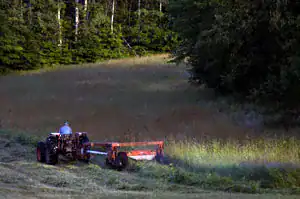
Grass–growing grass, drying grass, baled grass, chopped grass–is the engine that powers the Bromley farm. A cow turns grass into milk and manure. A framer turns milk into money and turns manure into fertilizer to grow more grass. It is a simple yet elegant cycle, repeated every day, twice a day over the years, over the decades and over the centuries. The greening of the meadows and pastures is the signal that finally and formally closes winter’s last chapter and starts anew on spring’s scrambled page. Spring does not start with the longer days or the warmer winds or the now boot high mud and slop out back of the barn. Nor is it the returning robins or the near empty silos and hay maws. These are all things of late winter when we are all seduced by the calendar into believing the grass really is greener on the other side of the snow fence. A dairy farmer sees growing grass as growing food, something that doesn’t have to be shoveled or spread or unloaded or hauled. A cow sees growing grass as something different to eat, something succulent and tasty and easy to chew, not something dry and coarse and so, so familiar. They both see growing grass as a reason to get out of the barn and stay out of the barn; more time to eat, less time to clean up and finally time to wander old paths. But Roger knows the winter pasture, greening as it may be in early April, is as wet and cold and ragged as an old towel left outside and forgotten. Put 50 cows out to pasture too early and the soft ground will be cut up like so much dirty confetti, killing tender grass shoots before they really get started and ruining it for later grazing. A dairy farmer sees a greening April pasture as a May mud hole lying in wait. The greening of the land does set off a cascade of activity on the farm, the end of each chore necessary for the beginning of the next. The back barnyard is scraped with tractor and blade, pushing up great blubbery mounds of mud and slop that ooze and sag and creep back toward the barn with every new rain. When the piles dry they will be scooped up with the backhoe and trucked down to Hoppers to be spread on the fields below. When the last snow melts and the phoebes have returned with the April rains it is time to mend all the fences of the farm. Every fence line is walked and every fence post–grown, cut and sharpened on the farm–is given one firm ‘tonk’ on top with a heavy iron mallet. Not two ‘tonks’–too easy to break an old but still useable post- and certainly not three. Just one solid ‘tonk’, and one ‘tonk’ only. If the post wobbles badly it is replaced, otherwise it is on to the next one. The miles of barbed wire are also inspected and repaired as needed; breaks are mended with spare lengths of wire and sags are tightened with a tug and a tap on the loosened or new staple in the post. Fence mending goes on all summer and fall; as long as there are cows in the pastures there will holes in the fences. Such is the relationship between a 1400-pound animal and a one-pound brain. Once the fences have been stitched back together and all the posts properly thumped- one ‘tonk’ only–it is time to begin moving all the cows to their summer quarters. First to see the other side of their fences are the oldest heifers that have spent the winter in the old heifer barn up top. They get released into the wilds of the high pastures; part meadows, part forest and completely unsupervised. They roam about like a gang of bovine hoods, happy to be ignored but always in want of some attention. Roger won’t have much to do with them until snow is in the air and the ground is well frozen. Down around the cow barn the youngest calves come out and move into the barnyard pushing the yearlings from behind the barn where they have spent all winter to across the old town road and into the long meadow above the sugar house. The calves are about a third of their adult size at this time but they will gain 300 lbs, a bit less than 2 pounds per day, by the time they come back to their wintering area behind the barn. The yearlings, the graduating class before the calves, are also packing on the pounds. They will gain 200 or more pounds over the next 6 months as they shed the last of their baby cuteness and grow into an adult’s bulk. The milk cows go up to the end of the old road and spend the entire day out and about, eating to their mighty stomach’s content. Each will be eating now for two, for every one, assuming the bull has done his job, should be several months pregnant. Soon, when there is enough grass to sustain them, they will stay out all night and the barn will be empty for much of the time. When trilliums bloom in the woods and barn swallows nest in the many old nooks it is time at last to turn the soil and plant corn seed. Once all the manure piles have been spread on the fields–about two weeks of afternoons if the weather cooperates and nothing breaks down- each field is harrowed two, sometimes three times. Harrowing disturbs the top four to five inches of soil, the first row of blades shoving the soil to the right and the following row pushing it back to the left. Plowing goes twice as deep and turns over the soil better but it takes twice as much time and brings up twice as many rocks. Roger tries to ignore the small rocks
Trish in the Barn
“So is this what it was like when I first started coming here?” Roger straightens up between the two cows he is milking, pushes his cap back and starts to slowly shake his head. His eyes though are in full twittering delight and with great drama, between not so quiet bursts of laughter, he places a hand on my shoulder and mustering up all the solemnity he can, which at the moment is precious little, he says in a voice thick with mock gravity “Yes, yes it was.” We both laugh now, remembering the silly and unnecessary ‘chores’ I did back when I first started coming to the barn. Back then, I did busywork in a working, busy barn. It wasn’t that I didn’t know any better. Well, okay, it was that I didn’t know any better but my ignorance was bolstered by my desire to be helpful or at least look helpful. I suppose I could’ve just asked what needed to be done and then gone ahead and done it. But I didn’t. I suppose I could’ve just watched quietly or I could’ve amused myself exploring the old barn. But I didn’t. I couldn’t just stand around and watch Roger work. Instead, I saw a broom and just started sweeping. Roger did give me a 10-second lecture on how to use the manure scraper (“It would’ve been 5 seconds if you hadn’t been a college graduate!”) but I didn’t have to attack so passionately every fresh pile of poop on impact. Nor did I have to so enthusiastically push forward whatever I had just pushed back and spread out what I had just piled up. I went around that barn like a toddler at a tea party- lots of commotion and nothing really getting done but with really stinky pants. Ah, but those were heady days in the barn: heady, clean days. Sweeping and scraping were about the only things I was able to do that didn’t involve constant monitoring by Roger and so I did them with fervor. I swept corners that hadn’t been swept in years, I swept behind tools that hadn’t been swept behind in months and I moved bags of I don’t know what that hadn’t ever been moved and swept behind them too. When I was done I swept again and when I was done sweeping I scraped and then scraped again. With me around, this wasn’t going to be just a cow barn! No matter how remote the chance, the threat of burning the place down or getting myself killed prevented me from doing anything truly helpful. Still, the outside aisles have never been so chaff free and both cow pies and cobwebs trembled at my frequent….very frequent, passing. The barn hasn’t been as spotless since. Roger finds ‘help’ like this quietly entertaining. He has good-naturedly suffered through many good-intentioned people coming to help him; from those who spend more time propped up on a shovel than pushing it to those who can’t stop pushing it. Being a one-man dairy operation, Roger has honed his chore routine to such a fine efficient edge that any radical variation to it is looked upon as Casanova might look upon a teenager on a first date, lots of action but nothing really getting done. My earnestly eager antics in the barn didn’t have a chance of being anything other than comical to Roger. I also remember the quiet tolerance and patience with which my efforts were received. Roger was always appreciative even when my efforts made more work for him or got in the way of what he was trying to do. He never once wondered, at least out loud…at least so I could hear, what it was that needed so much attention. For nine months Roger held in the fun of seeing me overly complicate the simplest tasks. It must have been a very long nine months for him. As new skills were added to my repertoire, my chores slowly became useful and more involved and I had less time to fiddle away. Still, with each new task I always over did the easily done and each time Roger suffered in silence. I did eventually master the proper use of the broom and scraper and today I am more judicious in my cleaning-sweeping and scraping just enough and no more. It is, after all, just a cow barn. If I over do jobs now- push up the feed more often than needed, reposition the wheelbarrow once again, respread the hay yet again – Roger will teasingly let me know it; “If you push that food around anymore they’ll never find it,” he will say or “If you sweep anymore we are going to have to pour a new floor.” or “ If you walk down this aisle any more empty handed someone is going to think you’re getting married!” Don’t assume, though, that Roger is a tyrannical taskmaster when it comes to doing chores his way. He will show me how he does something and I will try to do it the same way but I always miss the subtleties and end up with my own poor variation of his practiced technique. If my way is causing me more trouble than it should he will come over and suggest a different approach but he never demands it. “You could try it this way but it is up to you. Do it however you want, its your job.” He will say. And he means it. This is much different from how Roger was taught by his father, Hugh and how Hugh was taught by his father, Delos and how Delos was taught by his father Martin. There was no gentle guidance back then and no various ways to get something done. There was one way and one way only to do anything- the way it had always been done. “If my brothers and I didn’t do it the right way we’d hear about it, alright.
It’ll Be Interesting
“Hi. This is Roger,” a voice squeaks through my phone, “What’cha do’in?” “Ahh, nothing, “ I say suspiciously, knowing that I often am but he seldom is, especially at this time of night when there are still chores to be done. “Why don’t you come on over to the barn?” “Its after dinner, Roger, I’m already in my jammies.” I fib, slouched in my chair a glass of wine in my hand and my head blissfully empty. ‘That’s okay, the cows don’t care! There’s something in the barn you’ve never seen before. Come on over, it’ll be interesting.” It had only been a few months since I had met Roger but I recognized what he just said as Roger-speak for: a cow has done something really stupid and you’re not going to believe it unless you see it. That is the first part, the innocent part of Roger-speak. It is the second part, the ‘it’ll be interesting’ part, that is not so innocent. ‘It’ll be interesting’ in Roger-speak means: It is a real mess and I’m not sure how I am going to work it out but it would be nice if you were here to help me figure it out and get as dirty and frustrated as I am going to get. How can I resist an invitation like that? It’s 7pm when I leave my house, the slow part of the day when everything and everybody (except farmers) (and those who help farmers) have gone home to relax and enjoy a nice drink slouched in a comfortable chair. In the car I replay in my head the rest of the conversation: “One of the heifers calves got unhitched in the barn and got herself turned backward and hung up over the hitching rail.” “Hung up?” I ask bewildered. “Yes, hung up.” He says with a mixture of pride and exasperation. “On the hitching rail?” “Yes, she is hung up on the hitching rail….the pipe we tie the cows to. “You have a calf hung up over the hitching rail….backwards,’ I say still perplexed as comprehension is slow to make my acquaintance. “Yes. We have a calf hung up over the hitching rail and she’s backward,” the change in pronouns not lost on me despite my continued confusion. “Her front end is in the stall with her feet in the bedding and her back end is up over the hitching rail so that her rear feet are in the food, in the manger. The rail is running between her ribs and her hips so she can’t go anywhere. She didn’t seem like she was minding it much so I left her right there so she could think about things and went down and had supper.” “This could be interesting,” I say, rising from my chair. “I’ll be right there.” “I’ll see you at the barn,” says Roger. Arriving at the barn I meet Roger as he walks up from his house. Roger is in his mid-fifties, willow thin (he would have to gain 20 lbs. to be called skinny) and likely to be wearing something that is completely inappropriate. The middle son of three, he started feeding calves when he was just a boy and other than a few years in the army, he has spent his entire life on this, his family’s farm. Far from being worn out though, he still works harder than anyone I know, and does so with a smile, an easy laugh and a generous spirit. As we walk into the barn Roger grabs the long-handled metal scrapper and starts to clean up the center aisle. I turn quickly right and walk down the manger to take a look at the calf. I know Roger is watching me as he pretends to be busy; he loves these episodes. To him, it is like watching live TV in the barn. And I know what he wants to see. He wants to see me to jump and exclaim and celebrate the astonishing stupidity of this particular calf and all cows in general. He gets great satisfaction whenever he can have this primary bovine trait confirmed. It is a combination of ‘how big a fool can a cow be’ and ‘how big a fool must I be for depending on them to make my living.’ Roger is not your everyday dairy farmer. I come back scratching my head allowing him only partial satisfaction even though I am quite impressed with the idiocy of this animal. The calf really is stuck backward over the rail, just like an old pillow thrown over the back of a chair. “Maybe if I get in front of her I can push her back and she’ll be able to squirm her way over the pipe, “ I say not very convincingly. “She’s hard stuck” Roger replies, “I don’t think this is a one-man job.” “Well, let me try and if I can’t get her off I’ll come back and we’ll think of something else.” The change of pronouns is not lost on Roger. I walk back to the end of the barn and step between the two calves lying in their proper places. The circus cow stands above them, quietly chewing, looking contently at me. I put my hands on her head and push hard trying to turn her to one side and then the other figuring that if I can get her head turned the rest of her will follow. Nothing doing. I then try to push her straight back but she is having none of it. Push a calf forward and she’ll go backward. Push it backward and she’ll go forward. Besides, even though this is just a calf, it is still a big animal, perhaps 350 pounds and no one I know is ever going to push her off this rail. I ponder and then I try again adding a few grunts and choice words to my workout. Again nothing. The calf has barely noticed my efforts. Never
Good Morning, Hugh
“Good morning, sir” I say as cheerfully as I can this early in the morning to the old man in front of me. We are standing in the cow barn, in the cross aisle that separates the old part of the barn from the really old part. Fifty Holsteins in two parallel rows stand to either side of us eating their haylege as they wait to be milked. Their chomping sounds like a brigade of soldiers marching by in stocking feet. “Huh? Whad you say?” “Morning? Morning you say?” the old man replies as he notices me at his side and turns to see who I am. “Yes, morning, morning it is, looks like morning, yup, its morning.” I reply a tad louder and a tad too eager, a smile plastered across my face. “Is it?” he says staring up at me. “Well, yes it is, yes it was, at least I think it is, it was when I got here, morning that is. Yup, morning all right. Morning it is.” I answer, realizing I am making no sense. At least I am doing so loudly and with a smile, I think to myself, taking little solace in either. The man looks at me closer now, leaning in a bit, staring up at me and I get a very clear sense that he is marveling at the first babbling idiot he has ever seen in his barn. A jet of urine rockets from a nearby cow and splashes across our feet. “Huh” he says with finality and with authority, spits on the floor. I’m at a loss now. ‘Huh’ is pretty much of a conversation stopper especially when followed by a definitive spit. I fidget but I say nothing. A pause starts to grow between us. My smile begins to slip off my lips. Silence. I fidget some more. I can’t really argue with the man, it is his barn and his cows and I am standing in….God knows what I am standing in actually. And it is very obvious that he has seen far more mornings than I have. But I do have a pretty clear idea of what morning is, or I thought I did before this moment. Apparently, morning is the time of day not after dawn to this old farmer. It was my intention to make a good impression on my first visit to the farm or at least not make a bad one. I knew very little about farming and had never worked on a farm so the chance of me doing or saying something stupid was pretty high, perhaps even inevitable. I just didn’t want it to happen right away. It was now obvious to me and certainly this old gentleman and all the cows within hearing distance (which was all the cows) that at this I was failing and failing miserably. I had gotten to the barn at what I thought was the right time in the morning and had met Roger as he walked up to the barn from his house. “Are you going to take pictures this morning?” “No, not this morning,” I say. “I thought I would see if I could give you a hand, maybe help you out a little bit this morning.” “Well, come on in. The old man is in here somewhere I imagine. I’m sure we can find something for you to do.” Roger says this with a wink. It is his typical mixture of mischief and understatement that I find irresistible to this day. I follow Roger through the milkroom and into the barn. Its dark inside, no lights are on, only the soft light of the growing dawn illuminates the cows. The ‘old man’ is standing Yoda-like, leaning on an old broom, keeping watch in the gloom. “This is Hugh” Roger says to me keeping his introduction brief. “This is David Middleton,” he says to the ‘old man.’ “He’s a photographer. He’s here to help us this morning.” With that said, Roger heads for the cows, flipping on switches and grabbing an armful of milking equipment on his way. Roger is not much for small talk when there are cows to be milked. I am left with Hugh. I try another approach, determined to stand there long enough with Hugh until I begin to make some sense and say something intelligent. “So, these are the cows.” I say with full volume, realizing, as I say it that I will have to stand here a bit longer. “Huh?” “Some cows.” I say, practically yelling “Huh?” “COWS!” I am yelling now. This is in part because the vacuum pump, immediately above our heads, is now running and noisy and in part because I can’t think of anything else to do. Another pause germinates. Hugh is Roger’s father, 90 years old and still coming to the barn every day and doing what chores he can. He is a squat, solid man, mostly steady on his feet and mostly clear in his mind. A stroke some years ago, an artificial knee, bad feet and nine decades of hard work have taken their toll but his eyes are still bright and his grip is still strong and I adore him. I had been told about Hugh, warned actually. To the people of Danby, Hugh is known as either that old bastard up on the hill or just that old bastard. But to me Hugh has always been friendly, even charming at times, and always patient. His patience started on this first morning. “Who are you? What are you going to do?” Hugh asks me, mercifully breaking the silence. “My name is David Middleton. I am here to help you Hugh.” “Milton? Milton you say?” “Middleton” “Middondon?” “Middleton” “Milltown?” “I’m here to help” “Milltown,” Hugh repeats and lobs another blob of spit towards the floor. He says it again, “Milltown, I’ll be god damned, Milltown” He is smiling now. It occurs to me that either he is having some
New Boots & Milk Trick
1 SEPTEMBER 05 “Hugh, I bought a new pair of farm boots today.” “Oh, yeah, Whadcha get?” “Oh, just a pair of rubber boots – barn boots – for mucking and the mud.” “Like these?” he says pulling up his pant leg to show me a pair of old brown rubber boots he has probably had since the Great War. “Sorta like those, but I didn’t buy mine in Paris during the war.” I say unable to resist the temptation to needle him about his old, old boots. “You must mean World War I!” Hugh says with a laugh. “But Hugh, even if yours were new mine would be different than yours.” “They would?” “Yes, mine are blue.” I say this with considerable trepidation knowing that Hugh doesn’t embrace new things quickly especially if they are different from old things that have worked perfectly well for many, many years “Blue? Is that what you said? Your boots are blue?!?” I might as well be telling him that I have wings. In Hugh’s world when things work you don’t change them. If something wears out, you don’t throw them away, you just find something else it is now better suited for. “Yes, dark blue with a red line around the tread. Is that okay?” “Dark blue with a red? Those aren’t any good,” he says, his eyes twinkling with mischief. Then turning his head and spitting on the ground (it’s his visual exclamation point always placed at the beginning of important sentences) he says “Take the bastards back. Yes, sir, take the bastards back.” I laugh, a bit nervously, uncertain how serious Hugh is being. I didn’t take the bastards back. They were brand new and they were comfortable but I have boot trauma to this day. The last thing I want to do is embarrass Hugh when I am around the farm but I also don’t want to embarrass myself by looking like a farm yokel. These are the types of things I worried about when I first knew Hugh. I still worry. Just the other day Hugh noticed me wearing my blue boots with the red line around the tread as I walked by him on the way to the barn. In a voice loud enough for only me to hear he muttered, “Take the bastards back, yes sir, take the bastards back.” Then he turned and shuffled off, chuckling. 2 JUNE 05 “Bend down here and take a look. I’ll show you how this works.” I had asked Roger how the automatic milker, called the claw, worked. It looks like a 4-legged octopus that attaches to the utter by suction with a central glass jar where I could see milk swirling around. I bent over and peered under the cow at the claw in Roger’s hand. “No, get closer, you need to get closer to really see this.” So I get down on one knee and get my head almost under the cow, trying my best to please Roger with my enthusiasm. As I look at the utter Roger bends a teat and delivers a fine squirt of fresh milk at me, wetting my arms and shoulder. If it had been me I would’ve gotten my victim squarely in the face but Roger is too kind a person to do that so I just get a glancing blow of milk. This must be the oldest dairy practical joke in the world. I am sure that old Epheus, the first farmer in Mesopotamia, B.C. pulled this trick on everyone he could and that it has been done everyday since by someone someplace in the world where ever dairy farmers roam. You can put my name on June 2, 2005 as the one who kept the streak alive on that day.
Stuck Calf
“Why don’t you come on over? It is something you have never seen…it’ll be interesting.” This is Roger-code for: a cow has done something really stupid and you’re not going to believe it unless you see it. That is the innocent part of the message-the first part. It is the second part, the ‘it’ll be interesting’ part that is not so innocent. ‘It’ll be interesting’ decoded means: It is a real mess and I’m not sure how we are going to work it out but it would be nice if you were here to help me figure it out and get as dirty and frustrated as I am going to get. How do you say no to that? It’s 7pm when I leave my house, the still part of the day when everything and everybody (except farmers) has gone home and only the songs of birds stir up the quiet. In the car I replay in my head Roger’s words describing the situation: “One of the heifers calves got out and got herself turned backward hung up over the hitching rail.” “Hung up?” I ask bewildered. “Yes, hung up.” He says with a mixture of pride and exasperation. “On the hitching rail?” “Yes, she is hung up on the hitching rail….the pipe we tie the cows to. “You have a calf hung up over the hitching rail….backwards,’ I say still perplexed as comprehension is slow to make my acquaintance. “Yes. We have a calf hung up over the hitching rail and she’s backward,” the change in pronouns not lost on me despite my lingering confusion. “Her front end is in the stall with her feet in the trough and her back end is up over the hitching rail so that her feet are in the manger. The rail is running between her ribs and her hips so she can’t go anywhere. She didn’t seem like she was minding it much so I left her right there so she could think about things and went down and had supper. Why don’t you come on over? It’ll be interesting.” Arriving at the barn I meet Roger as he walks up from his house. As we walk into the barn Roger grabs the scrapper to start to clean up the center aisle before milking and I walk down to take a look at the calf. I know Roger is watching me even though he is pretending to look busy. He wants me to jump and exclaim and celebrate the astonishing stupidity of this particular calf and all cows in general. He gets great satisfaction whenever he can have this primary bovine trait confirmed. It is a combination of ‘how big a fool can a cow be’ and ‘how big a fool must I be for depending on them to make my living.’ I come back scratching my head allowing him only partial satisfaction. The calf is hung up like an old pillow thrown over the back of a chair. “Maybe if I get in front of her I can push her back and she’ll be able to squirm her way over the pipe. I don’t want to get behind her and get in the way of those feet.” “She’s hard stuck” Roger replies, “I don’t think this is a one-man job.” This is Roger’s nice way of saying “Any fool can see it is at least a two man job but if you want to confirm this by giving it a go yourself, go right ahead.” “Well, let me try and if I can’t get her off I’ll come back and we’ll think of something else.” I walk back to the end of the barn and step between the two claves lying in their proper places. The circus cow stands above them, quietly, looking contently at me. I put my hands on her head to try to turn her or push her but she is having nothing of it. This is a big animal, perhaps 350 pounds and no photographer/writer that I know is ever going to move her when she is stuck as fast as she is now. I give up the brawn approach immediately and start the brain approach when Roger arrives carrying an old 15 foot piece of rope with a loop on one end. I am perplexed but don’t be alarmed at this. I am perplexed or at least befuddled more times than not when I am in the barn. In fact, befuddlement is pretty much my normal state when on the farm. But I come by it honestly. I have no experience unhanging heifer calves. I was not taught this in school. I have read no books on the subject. It is not a popular topic for TV shows. You never see this on ESPN. It has never, ever come up in idle conversation and it is not something anyone I know has any experience with. Anyone, that is, except Roger. Roger has 50 years in the barn and he has seen and had to deal with 50 years of idiot cows. He may not have dealt with this exact situation but I know he has dealt with situations that are similar enough to apply to this predicament. I am sure he has had cows hung up on fences, gates and downed tree limbs before and since I haven’t seen any skeletons draped over any of these things on my wanderings around the farm he must have been successful unsticking the stuck. Getting a calf off a hitching rail is just another opportunity to use those same old tricks. Furthermore, this is exactly the kind of thing farmers do talk about. Listen in on a conversation between farmers and you will either hear complaints about the weather or stories of the things that didn’t go right- the tractor that broke down, the hay wagon that got stuck, the bull that was too lazy to do its job or the raccoons in the silo. Even if you were
On Becoming a Pro
Chapter 4 – American Vision – Amphoto Books Imagine yourself as a participant at a workshop that features John Shaw, Wayne Lynch and David Middleton as teachers. In the late afternoon, you are invited to join them on the terrace of the lodge for a beer and conversation. After the beers arrive and all pretense of formality depart you decide to ask them about what it takes to become a professional nature photographer. You are hoping the answers come more quickly then the refills. Your first question is: “What is an important characteristic of a pro?” After you receive three utterly blank stares you decide to rephrase the question: “How would you define an accomplished photographer?” John Shaw is the first to respond: “Learning when not to photograph is just as important as learning when to shoot. This process involves learning to see your subject as your film will see it. The human eye can accommodate roughly 10 to 12 stops of contrast; that is, we can look at a very contrasty scene and see detail in both the shadow and highlight area. Not so with film. Modern color slide films have at most a 5 stop range of light which they can record in any one image. A professional has to learn how to apply this limited vision when determining exposures. From a medium, or middle-toned, exposure value slide film can only record tones from 2 1/2 stops lighter (pure white) to 2 1/2 stops darker (pure black). The pro has to be able to analyze a scene and determine if indeed it is possible to record his vision. He must know what the results will look like on film, even before the shutter is tripped. This knowledge lets the pro decide where to place tonal values and what details to sacrifice if necessary.” David Middleton pipes up next: “I would answer by saying a pro is one who spends more time looking for something to photograph then actually photographing it. I am always amazed when I am out in the field and see a group of photographers pull up, jump out of their cars, walk to the nearest whatever and begin photographing! Now, how do they know that there isn’t something better to shoot just over there or around the corner? And what are the chances that they happened to park next to the best thing there is to photograph? The answer is: nil. A professional photographer gets out of his vehicle and wanders first, looking over the entire area. In any one spot there are only a few things to photograph. Better to spend the time looking for those shots then waste it photographing something that could be better.” Practically bursting, Wayne Lynch, who has spent a lifetime studying and photographing animal behavior, knows that photographing any wild creature begins long before he steps into the field. “I think every nature photographer should also strive to be a good naturalist. Too often I have met wildlife photographers who didn’t know the difference between a northern moose and a chocolate mousse. The more you know about an animal the less likely you are to endanger it or compromise its survival. Understanding the biology of your subject will also alert you to subtle aspects of its behavior that you may otherwise overlook and fail to capture on film. Finally, knowledge of an animal is also the best insurance against injury. Many wild animals are unforgiving and will reprimand your clumsy ignorance with a bruising, or worse.” Your next question is a bit more practical: “How do you approach shooting in the field?” Middleton starts this time: “Photograph that which you are passionate about. Your passion will be evident into your images. If you photograph that which you don’t care about your ambivalence will be translated into your images and no matter the situation your shots will be mediocre. I also allow a lot of time in the field to just absorb what is going on around me. I am not only talking about any animal activity but also the play of light and the relationship of the shapes and patterns that are around. This is especially important for me if I am coming to an area that I haven’t photographed for awhile. If I don’t take the time to slow down and begin seeing anew my first rolls will be disappointing. This is another reason I think wandering is so important. Just put your hands in your pockets and go for a stroll.” Shaw continues: “I agree, first and foremost you should photograph the subject matter which you truly love. Even as a professional there is a difference between shooting for pleasure (even if you sell the resulting photos) and shooting solely as a commercial venture. Your emotional commitment is usually apparent in the quality of the pictures. If you like working all kinds of natural history subjects, do so. If you’re only interested in bird photography, fine. If all you want to do are landscapes, so be it. Just remember that in terms of sales it certainly helps to diversify and to have unique coverage. Some subjects have been photographed so often, and are so easy to photograph, that selling the resulting shots is very difficult. Egrets and herons from Florida, common wildflowers, Yellowstone elk, and National Park vistas shot directly from the scenic pulloffs are four examples. Sure, you should have these in your file. But if one of these subjects is all that you photograph you’ll have a difficult time selling many photos. The same is true if you specialize too much. Only so many photos of bats or mushrooms are published in one year. You should also differentiate between what is “interesting” and what is “photo-graphic.” Aesthetically pleasing shots will sell far more than merely “interesting” work. This is because ‘pretty’ is more universal than ‘interesting’. Most of us agree what is pretty but what is interesting to you may not be interesting to me.
New Photo Year
The Nature Photographer’s Year The most common question I am asked as a professional nature photographer is “When is the best time to go to ______?” You fill in the blank – Texas or Tucson to photograph wildflowers; Vermont or Colorado for Fall colors; the Rockies for bugling elk; Alaska or Africa; Churchill for polar bears. As far as I know there are no timetables to consult or atlases that show the progressing seasons. But, unless you know the peak time, you are likely to arrive too late or too early and spend your time photographing the not-quite instead of the couldn’t-be-better. Don’t you just hate to hear “In a week this will be just great” or “Wow, you should’ve been here last week”? In an effort to make all your photography as productive as possible, I have mapped out an entire year with the best places to go at the best times. Let this be a bit of inspiration, sort of a photographer’s fantasy year. It would be interesting to actually jump in a car for a year and race the seasons from location to location clicking off the miles, cups of coffee and film canisters (let me know how it goes). A word of warning about the listed times of year. These are the typical dates for each event on a normal year. Unfortunately, normal years are as common as fascinating politicians and low-cal donuts. For example, this last year the alpine columbine in Colorado that should have bloomed the first week of July did not bloom until the middle of August and the fields of alpine flowers that should have bloomed in mid-July did not bloom at all! Consequently, the aspens that did turn golden did so in the middle of October instead of the middle of September, most aspens just dropped their leaves green. But not everything was late. In the Smokies, dogwoods bloomed 2 weeks early and in the Arizona desert poppies were a month early. I don’t mean to imply that you are out of luck if you go somewhere and the seasons are screwy. If you are too early go lower in altitude, farther south or work south-facing slopes. If you are too late go higher in altitude, farther north or work north-facing slopes. JANUARY Weeks 1 – Oregon coast. Why go to Oregon in January? Because there is no better place to photograph the Pacific coast and winter. Anywhere along the Oregon coast, all open to the public, it is possible to find wintering birds, seals and whales, great lighthouses and harbors, wonderful tide pools and spectacular coastal landscapes. And you will have the place to yourself! Try Bandon or the Newport area or the dunes around Florence. For more information get a copy of The Photographer’s Guide to the Oregon Coast that I did with Rod Barbee. Week 2 – Oregon Mountains. When you want to try something different, head up into the mountains where you will find piles of soft snow adorning magnificent trees and draped over the landscape. Any of the half-dozen roads that cross the Cascades will take you to this winter wonderland. Long the way you will find plowed out parking lots, called snow parks, where it is possible to park (a small fee is sometimes required) and also take pictures. My favorite is Santiam Pass on Route 20. Weeks 3 & 4 – Death Valley and Slot Canyons of the Southwest. For those of you who cannot suffer the cold head for the deserts of the Southwest, in particular Death Valley and the slot canyons of northern Arizona. Death Valley is great in winter because the temperatures are tolerable so you can linger longer. Besides, it is not as if you are going to be photographing a lot that is living in a place called Death Valley so you might as well go in winter. The bizarre landscapes don’t change and you won’t have to worry about frying your film or your brain. Same can be said for the slot canyons. The most famous is Antelope Canyon just southeast of Page, Arizona but there are others less well know that are just as interesting. Try the Paria Canyon area or ask at the BLM office for other locales. Be sure to ask locally about road conditions and permits. FEBRUARY Week 1 – Triple D Game Farm. Triple D is by far the best mammal shoot, with the most marketable animals, the best looking animals and the best handlers and settings. The animals are extremely well trained and many different enclosures are used so you get unique photos and not the same old animal on the same old rock or worn log. It is not as cold in Kalispell in February as you think. Weeks 2 & 3 – Yellowstone National Park. For those who want wild animals and great snowscapes Yellowstone can’t be beat. From Mammoth or Gardiner, on the north side of the park, you can easily drive to herds of big-horn sheep, bison, pronghorns and elk. Plus, you can take a snow coach tour or rent a snowmobile to visit the geyser basins in the interior of the park. Week 4 – Gulf coast of Florida. For those cold-blooded souls who crave warmth and good photography. Ding Darling National Wildlife Refuge on Sanibel Island is a magnet for wintering ducks, long-legged waders and pale-skinned snowbirds. You will find ducks, herons, egrets, spoonbills, pelicans, hawks and osprey, most in breeding plumage. Be sure to spend at least a day at the now famous heron rookery up the coast in Venice. It is located behind the police station on a man-made island and gives you close, eye level views of the nesting birds. This is where those fantastic heron and egret photos have been taken. Also try the Fort DeSoto area south of Tampa. MARCH Week 1 – Harp seals of the Magdalen Islands, Canada. Nothing is cuter or more photogenic than a harp seal pup lying in its icy cradle.