Pics from new camera
I have been out shooting with my new little camera, the NIkon 1 J3) and so far I like it! There are a few oddities- no histogram, ISO is buried in the menu, finding a 40.5mm circular polarizer, finding a case that will work- and a few things I need to get used to- no viewfinder, shooting with live view, tiny controls- but overall it is a camera that is easy to use and it takes very very nice images. I particularly like the 16-35mm ( 35mm equivalent) lens- such a wide lens for such a tiny camera. It is almost like the perspective of a GoPro camera- tiny and wide and able to go places you would never put a full sized camera. This morning at the farm I reached between a cow’s legs and snapped off a few very odd but strangely compelling pictures. Tomorrow I am going to try this when Roger is milking. Four cow feet, Roger, one milker and one straining udder- seems like a perfectly reasonably situation for photography! The photos of the crabapple and lilac blossoms were taken in my yard, handheld and before I had read any of the instructions. I was holding the camera above me head to see how that would work. The stream is Big Branch and is about 3 miles from my house. I got there just as a thunderstorm was starting so I went to the closest place and took a shot I have taken several times before. I used a tripod and the 16mm lens with a polarizer. I plan to go back there tomorrow without the benefit of thunder and lightning. I’ll keep you posted but so far so good!
Come on, People!!!
How long were all of you, my gentle readers, going to remain silent about my nonsense about showing you pictures from my phone? A phone!! A phone is not a camera!!! Yes a phone can take a picture but that is not the definition of a camera to me. A phone is as much of a camera as a hubcap is a frying pan! And you can’t do photography with a phone. You can record a scene in front of you but you can’t photograph it. So why am I going to amazing aquariums and trying to capture the wonder with a phone? Because I’m an idiot! Anybody care to argue with me? Didn’t think so. I’m also indecisive, well I was until last week. I should probably explain. For at least the last couple of years I have been wanting to buy a small camera as an alternative to my giant Nikon D4. Something that is inconspicuous, easy to carry around but still takes good useable pictures and is easy to use. there are many options available- Panasonic Lumix, the Canon G cameras, Sony make really good little cameras, Leica, Fuji and, of course, Nikon. I had a small Panasonic a few years ago but it was so small it was hard to use. I then had a Nikon D5100 which is a real, full sized camera but it never felt comfortable in my hands or in my head. I gave both of them away. Each one of the little cameras has its advantages and disadvantages. I came to realize that there is not the perfect little camera out there. As soon as I found a model I really liked I discovered what I thought was a fatal flaw. I then realized that every camera has a fatal flaw or two and that not all fatal flaws are so fatal. This didn’t help my decision making so much- I went from eliminating every option to embracing every option- thus no decision. This is why I took so many pictures with my phone and why I shared so many of them with you all. Those days are now over! Meet my new little friend! I went with the new Nikon 1 J3. It takes pictures in RAW, does good full HD video, allows me to shoot in aperture priority and has interchangeable lenses. The lens that sold me on this camera was the equivalent of a 16mm lens. Most other little cameras have wide angle lenses that only go to 28mm- I wanted something much wider. I got three lenses to go with the body- the 35mm equivalent of a 16-35, 27-85 and a 27-270. I’m going to take it on my next two big trips to British Columbia and Brazil and will be sharing lots of pictures and thoughts on it. Be happy to know that my days of posting iPhone shots are over. Never again will I resort to that hubcap appliance for photography! Well, almost never. the shots in this blog were taken with my iPhone!
Living Water

A week ago, in between two of my trips I had a chance to actually go out and take some pictures. Didn’t have any purpose in mind other than to be out photographing- the just for fun kind of photography that we all used to do all the time before assignments and contests and projects and competitions got in the way of our enjoyment. Today I had my first chance to look at the pictures- perfectly nice, nothing earth shatteringly spectacular- photos of a stream. What caught my eye as I was editing the images was the variation between images that were taken only moments apart. Not variation of composition or exposure but variation of subject matter- the steam changed dramatically between every shot! Yes I mean dramatically. Where in one image there was water pouring over a rock in the very next one there was none. It changed the composition completely. I include two pairs of images taken seconds apart. Notice how water appears and then disappears, how the stick on the right is mostly hidden and then mostly visible. These are big differences that strongly effect each composition. I prefer the ones with more water coming over the rocks but I gotta say that I didn’t notice the difference at the time, I just shot my usual burst of three or four images and didn’t think about it. I have always known that water surges in steams. Sometimes the surge is on a daily schedule with low water in the morning and higher water in the afternoon, sometimes it is on a temperature schedule- higher temperatures generally mean higher water. but I never fully realized that water in a stream can vary so much moment to moment. It is like the stream had a pulse, a watery rhythm, an energy that flowed and ebbed. I don’t know where such a rhythm comes from or why it happens and I don’t really care to know but I am thrilled to now realize it, to be just a bit more connected to the nature of that stream. What does this mean photographically? I suppose not much. I would suggest though that from now on when you are taking pictures at a stream you should shoot a short burst of images to capture the perfect watery swell or the wanted watery ebb. The water is alive, it has a pulse. Sit and watch for a spell before you take your shots. Who knows what else you might discover?
More Aquarium Photos

Yes I am still here- sorry for my absence. While I haven’t been doing very much serious photography lately, very much of anything actually, I did visit the Monterey Aquarium last week for nothing more than fun. I love aquariums- I consider them houses of wonder and keepers of magic for the other-worldliness of what is found within. Remember, three quarters of the world is underwater, we land dwellers inhabit the minority of space, so there is much to see and much to marvel at under water. I particularly love the soft filtered light, the bizarre forms and textures and the equally bizarre colors of the critters you see in an aquarium. The weird fish, the weirder anemones, and the weirdest I-don’t-now-what-the-heck-it-is I find wondrous and delightful to photograph. I haven’t photographed any of it very well but it sure is fun trying, and trying, and trying. I always seem to have only my iPhone with me when I am in an aquarium- a bit of a double edged sword. I’m glad I have something to take a picture with but the limitations of a camera phone make most photography problematic. This is especially true for close-ups, contrasty situations and any shots that require lots of depth of field. I still try them (because it’s fun) but I am usually disappointed. Here are my latest aquarium photography efforts.If you have an aquarium near where you live go and visit. If you happen to be traveling near one please stop in and find the wonder within. If you are stuck nowhere near an aquarium go to Atlanta or Monterey for any reason you can think of and enjoy yourself. And take your camera!
Creating Compositions
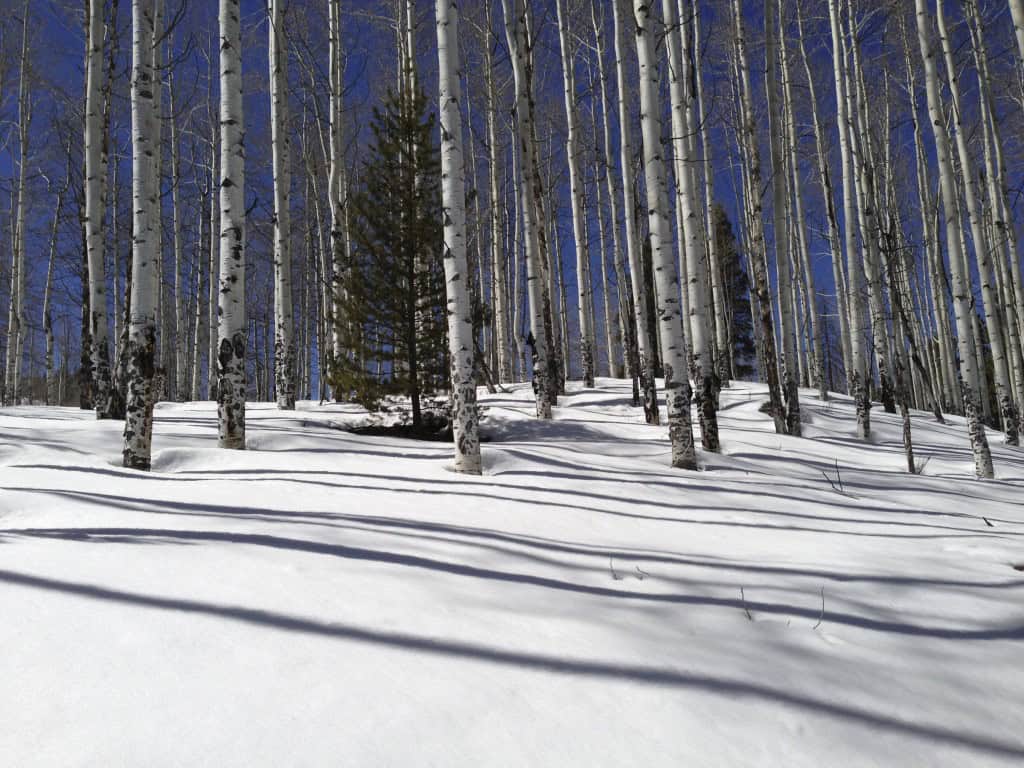
I’m out in Colorado again for my last trip of this winter. It’s been gorgeous so I’ve been out stomping around the woods on my snowshoes for fun and exercise. This time of year when the snow is heavy and soft walking through the thick snow requires considerable effort so I didn’t bring my adult camera with me on my jaunts, just my IPhone 5. Bringing something, anything along for picture taking is important because it forces you to stop and retrieve your lungs, the result of snowshoeing at 8000 feet. So I’m out wandering around and I notice that on the way up the hill with pristine snow in front the compositions are quite different than when I’m coming down the hill on the same path with my tracks in front. Not saying one is better than the other, just different. So I set out to capture the two different compositions on my phone so I could compare them and share them. Notice how much different the pair of images feel: the pristine one almost unapproachable and the tracked one so inviting. This led me to realize that when you are leaving tracks, whether in snow or sand or dust or through a wet meadow, you should be deliberate with your path. Look at the landscape and decide where you want your path to go. In effect, you are creating your composition, tracing it on to landscape. This approach works with foot steps on a beach (how close to the waves? straight line or curved?), in dunes (along the ridge line ? cutting across?) or in a wet field (straight across? s-shaped? bottom to top?). And of course, it works in snow. We often photograph what we come across and are at the mercy of the elements to define the composition. With footprints, take no mercy. Take a shot of the untracked landscape and then trace the artistic line you want. Then come back and take your picture. You’ll have two shots of the same environment that are completely different.
White horse blizzard photography
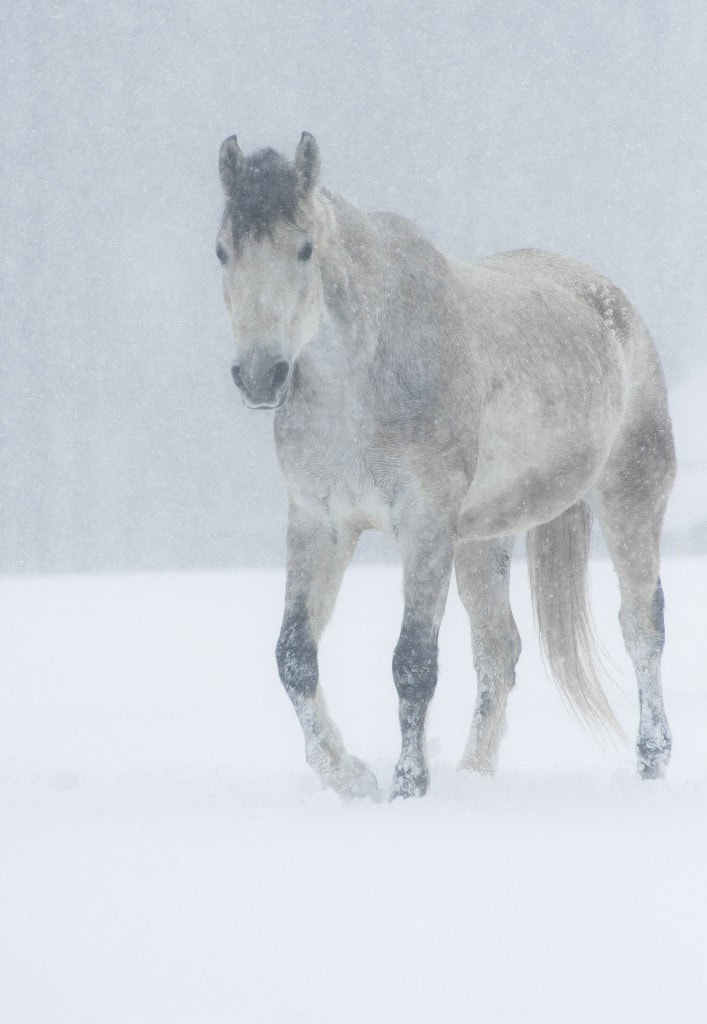
I have a new rule: If it is winter and it is snowing hard with strong winds and it is cold I will not answer the phone. Curious rule, huh? Why? Because when I do I know that it is my friend Lisa Cueman on the line and she wants to play. No, not checkers, she wants to play outside in the snow and wind and cold photographing horses. What? You expect me to say no? Lisa is a wonderful fine art photographer. She used to be one of my students until she realized that if she did everything opposite of what I said it would lead her to fame and fortune. Now she has several big city galleries showing her work and she is working on several one-person shows. She also realized that when it comes to horse photography I am far more useful wrangling than giving photography advice. When I see her finished prints I realize the same thing- get out of her way and deal with the horses. So there I was this afternoon in the middle of a heavy snow storm running the fence line with a bucket of horse treats trying to get the horses away from Lisa so she could get pictures of them running back to her. We did this for two hours! I snuck a few shots in here and there just to have proof I was out there is such conditions. I used my 28-300mm with a lens hood and hand held pretty much wide open at ISO 800 to get adequate shutter speed. My shots are nice. The images I saw on the back of Lisa’s camera are really nice and several are spectacular. Go to her website- http://www.lisacuemanphotography.com – and see some of her winter horse images under her equine photography/black and white II tab. The gray horse with the black mane is Riva, the white horse with the very long mane is Haley. The fuzzy figure in the background that has been cleverly excised is yours truly running the fence line. Enjoy, but don’t call me unless it is sunny out.
Pacific Rim National Park
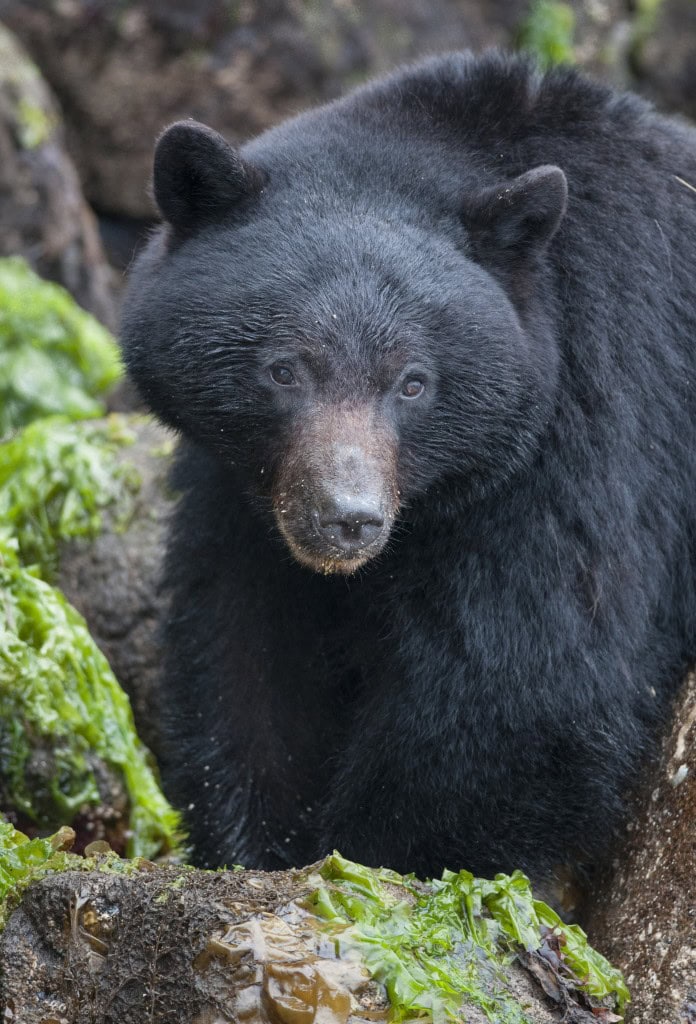
The Pacific Rim National Park workshop is fast approaching and we have just a few spots left before it is full. This is one of my all time favorite workshop locations because there is so much to photograph and it is all spectacular. It is, after all, held within a world biosphere reserve! Don’t miss this one- it is great! The western edge of Vancouver Island is a wild crenellated coastline of deep bays, rocky headlands, broad tidal flats and small harbor towns decorated with ancient forests, clear waters and wide, inviting beaches. About midway on the coast, where the Pacific dips inland to form the Clayoquot Sound, a long finger of land reaches up and tickles both waters. At the south end of this peninsula is the charming fishing village of Ucluelet, at the north end, the more hip surfing town of Tofino. In between lies the Pacific Rim National Park and, surrounding it all, the Clayoquot Sound World Biosphere Reserve. The workshop will be based in Tofino on the north end of the Long Beach unit of the Park. Aptly named, Long Beach is 22 kilometers of gorgeous white sand fringed by beautiful stands of old-growth Sitka Spruce and dotted with rocky spires encrusted with giant purple sea stars and vivid green anemones. Off shore, sea lions and gray whales loll in the Pacific surf, while on the Sound side, black bears prowl the shore- line at low tide plucking crabs from beneath the kelp and boulders. This was my quote when I went back to explore the area for the workshop: “Having spent 25 years photographing the Oregon and Washington coast I was awed by the abundance of nature and the variety of subjects to photograph in the area. I fell in love with the place and can’t wait to go back.” With that kind of endorsement you should just stop and reading now and send in your deposit! There are so many favorite places to photograph on this workshop it’s hard to name them all. Highlights of the week will include visits to Chesterman and Combers beaches. These pristine shores are approached by winding trails through beautiful forests that open up onto long sandy strands with sea stacks just offshore. We are also certain to visit Cox Bay early in the morning mist in order to photo- graph its many anemone filled tide pools, only to return to catch the surfers riding the waves at sunset. During the workshop we will travel by water taxi to Mears Island. Mears Island was at the center of many conservation-versus-logging conflicts and is renowned world wide for its trail through an old-growth forest of several thousand year old giant red cedars. We will also take you to a grove of magnificent old-growth Sitka Spruce that line the twisting boardwalks of the Rainforest Loop Trail. Wait, have we mentioned photographing black bears from a small boat as they hunt crabs on the shore? We probably should have started here, as this private, chartered excursion may very well turn out to be your personal highlight of the workshop. The boat will be ours alone, and the captain is well versed in getting us the best angle on the local ursine population. The bears are so close that the splash of each footfall and the emphatic crunch of each bite are easily heard. If you are interested contact my co-leader, Brenda Berry- [email protected]. She will give you all the details. Please join us, I promise you won’t regret it.
Completed Video and some thoughts

I finally completed the video I started to edit with Bob Krist two weeks ago. I have included it below. It is also on vimeo if the link below sends you astray. Here is what I have learned about video: It’s fun to shoot and even more fun to think about what to shoot and how to shoot it. This is especially true for all us old-timers who have photographed for years and are in such a rut we don’t recognized it anymore. Learning video (or anything new) gets you out of your photography rut. It took me about 5 hours to shoot the 64 clips of winter streams over three days of shooting. I missed one perfect day for shooting but otherwise I had pretty good luck. It took me about 5 hours of editing to assemble the video and another 5 hours to learn how to do it. Yu will see that the editing technique is very basic but it is good enough for a nice piece. I have the fundamentals down, now I can add the fancy stuff. I used Final Cut Pro X (ten) as my editing software and I found it to be very straight forward and intuitive to use. All the FCP X horror stories that I had heard had me pretty nervous to try to use it but it was a joy to use. I started with iMovie but found it to be frustrating to use. iMovie is like a entry level digital camera- it tells you what to do and then fights you if you try to do something differently. A more sophisticated camera or software works with you. I got frustrated with iMovie in 15 minutes- FCP X was great. Don’t listen to all the naysayers, try it, you’ll like it. To learn FCP X I searched for clear, easy to understand and follow tutorials on the web. There are a ton of choices. the one I used was www.izzyvideo.com. Izzy speaks clearly and slowly and shows you FCP X in an orderly and intuitive way. I went through the first 15 lessons (each lesson is 4-12 minutes long) twice, took notes and then dived right in. FCP X is much more like Lightroom then it is Photoshop as far as ease of using goes. I still have lots to learn with FCP X, don’t get me wrong, but at least now I have a start. I also ordered three books two of which were awful and the third just okay. Still looking for the definitive FCP X book. And the video isn’t finished yet. I need to refine the sound a bit and the video needs a title and closing credits (seems to be the convention). Every time I look at it I see another place that needs a bit more polishing but that’s okay. There’s always tomorrow. Hope you enjoy this little interlude!
Another Video? The Breakfast Thief
I can’t say that people are clamoring for more videos, in fact I can’t say that they have even been noticed by very many people but I can say that I’m going to give you more. Why, might you ask, am I venturing into video when I have finally gotten some mastery of photography? First I haven’t given up photography- and I never will. Second, video is just another way to tell a story and as all those poor suffering souls who have taken a workshops with me know, I am first and foremost a teller of stories. With still photography, video and writing I feel I am just now getting the skills needed to tell a rich, compelling story. With anything new though my learning curve is steep and my ability to not show you my incremental progress limited. I will say that the quality of my video equipment far exceeds the skill that I have with video. I am hoping that it doesn’t exceed my talent but that remains to be seen. I will keep sharing my steps along the video learning curve and include the lessons I have learned. The video I include here is a short silly piece that I did with my friend Brenda Berry in Bob Krist’s kitchen. We were trying to learn the conceptualization of shooting video- what shots we needed and how to shoot them. Brenda did most of the photography, I played the breakfast chump. Bob’s refrigerator played Bob’s refrigerator (there’s very little range to a refrigerator). I will announce the opening date this will play at Sundance next year in a later post. Enjoy!
Another Video for your Digestion
I’ve been down at Bob Krist’s doing a short workshop on video. this is my unfinished work on a stream near my house. Enjoy! Okay, here is the full story: I did a four day private workshop with Bob Krist last week. He is a great friend and is equally curmudgeonly as I am (hard to believe!). The clips for this video I had shot a couple of weeks ago and I brought them down to Bob to have some material to work on. this is what I learned- I didn’t shoot nearly enough clips! This is why the music doesn’t finish and some of the shots don’t quite work (I know, I am hyper critical of my own work). I need more detail images and a few more overall shots. Also I will now add some clips with some camera movement making the photography less tedious. But given what I had this brief video is a nice start. I plan to go out and shoot some more of Big Branch and then add the new to the old and rework the piece. I might even go out today if the weather cooperates.