More maine pics

It was a funny fall this year. Not much color at first and then nothing for the first week of October. Then, around the end of the second week of October there was a little cold snap and what leaves were left came ablaze. The only time I had to photograph it was a few hours between consecutive workshops, in the rain. But you do the best you can and keep your wits and sometimes things work out. The reason it is a square format is because the book is square so I composed and cropped to square to take advantage of most of the page.
Maine Pics

Boy, was it cold up here this morning! We did a sunrise shoot and my students got some very nice images. On the way back to the car and snapped of this shot looking south to the Cranberry Isles. I then hightailed it back to the warm car and we headed down to the coast.
Maine Pics

I have just gotten back from two weeks in Acadia National Park doing two workshops and in a matter of hours I will be on my way to New Zealand for a little Rand R. In the mean time I thought I would share with you a few of my last images that I am submitting for my Maine Memories book. Hope you like them!
Editing your images
I am just finishing my third workshop in a row- one in Vermont and two in Acadia National Park in Maine- and I have noticed several recurring themes among my students. The big one is that nobody seems to ever throw any of their images away! Even ones that are obviously flawed or downright bad are still on their computers many months after they were taken. there is no good reason to ever keep very bad photos on your computer. Nor is there any reason to keep 20 versions of exactly the same image. If they are all the same get rid of all but two. If there are some important differences between the images decide which ones you like the best and get rid of the rest. Too many times students give me images for review and critique and then say “Oh, I gave you the bad one. I have a better one in my computer.” If you have a better one get rid of the bad one! To help you decide what to save and what to get rid of I have included below my criteria for editing my images (in other words, for getting rid of the clunkers). The first deleting pass is in the camera. The next deleting passes are done in the computer. Each pass gets increasingly more specific and more picky until I am left with just the best images from the shoot. Here is the Editing Criteria handout: A. In camera- quicker, gross, overall considerations 1. Exposure Significant blown highlights or blocked-up blacks 2. Composition Light good? Subject the best? Background not distracting? Conditions optimum? Phrase (good) or Sentence (bad)? 3. Focus Eyes of animals, main subject, distracting blurs elsewhere B. In computer- slower more specific considerations 1. First pass- looking again for obvious problems Exposure Highlights, Blocked up blacks Composition Light, Subject, Background, Conditions Phrase or Sentence? Focus Too much? Too little? 2. Second pass- more carefully considering choices, comparing to best pics Composition Chopped body parts, bad merges, frame filling? Focus All of eye? both eyes? Critically in focus? Expression/Gesture For portraits, movement (actual or implied) Pretty? or just Interesting Noise Manageable or deadly 3. Third pass- keep only best one or two per composition Story Does it help tell the story? Need Do I need it? Might I need it? Impression Does it work? Does it sing?
Bursts

Most of the time when I am out taking pictures I am shooting a single frame at a time. This is because I am taking my time, waiting for just the right moment where the wind, and light and subject all conspire to give me the best that I can get. But there are times when instead of being so deliberate I am just the opposite- I shoot in short bursts of 5 or 6 images. I do this whenever I am photographing something that is moving and whenever the expression of my subject is important. Shooting on fast motor drive for a second or two allows you to concentrate the subtle differences between each shot when you are reviewing your images and pick the best one from the series. Now, let’s be clear about what I am saying. I am not recommending to just blast away and see what you get. I am recommending that when the situation is right you take a burst of shots. The reason this technique works is because the subtle differences of gesture and expression- how high the hand is, how far the head is turned, the separation between the arm and the leg, the openness of the eye, the curl of the lip, the cock or the head- can be the difference between a nice shot and a great shot. Just be sure to toss away the inferior images and keep only the best ones or else you are going to be swamped with shots you will never ever use. On the example I have included here I saw the lobstermen heading out to his boat in the fog and saw that there was a brief window in which he would be nicely framed by the boats in the background. I took a total of 8 shots. In 6 of those shots the lobstermen’s head or arm was turned is such a way that the composition suffered. In the shot I selected, the lobsterman’s head was up and turned so I could make out his face and brim of his hat and his right arm was not merged with his right leg. I saw none of this while I was taking the burst. I was just trying to keep my autofocus bracket on the lobsterman and watching the background so I would stop shooting when the boat merged with the background boats. The differences were noticeable when I was looking at my images on my laptop. That was when I was glad I had several shots from which to choose. Shoot short bursts when things are looking good and subtle differences might make a huge difference. You’ll be glad you did.
Fall Color Update
So what is the status of the New England Fall color? Hard to say. Last week there were a couple of days when I thought the season would pass before it even started but now with a week of warm wet weather the color progression seems to have stalled. I now think that the season can officially be called “screwy.” There are some spots at higher elevations where the reds have already fallen and the yellows of the beaches have started early but over most of central Vermont (and I assume central New Hampshire) green is still the dominant color. Here is what I am thinking if you are already in the area and looking for color and have the freedom to travel- go east. the farther east you can go I think the better the color will be. This is because eastern New England got much less rain from Irene and the subsequent storms so the color will be closer to normal. The mountains of western Maine, the Katahdin area and the mountains of the Maine coast (Acadia National Park) I am guessing will have the best color. This is just a guess, but it is an educated guess and I am sticking with it. There are pockets of exceptional color everywhere- it will just take a bit of looking this year. The dairy farm is looking great!
New England Fall Color update
I have been asked a lot lately about the potential for fall color this year. My answer is the same for everyone- I don’t know! In fact, no one knows for sure no matter how definitive he or she might sound. Here is what I know and can see- We had a bit of a cool spell in mid-September causing some trees to show some color early but now (almost October) it is warm and wet so the progression to full color seems to have stopped or at least slowed. Mountainsides are 95% green in central to southern Vermont but some valley bottoms are bright red (from the early turning red maples). When will the peak color be? Got me! Traditionally the best color is between October 10th – 14th, I have no reason to think differently this year. If you are coming up during the first week of October head to northern Vermont, New Hampshire and Maine. During the second week of October you can go where ever you wish, there should be good color everywhere. Head for the coast of New England during the third week of October and go to New Jersey and Maryland and the Smokies at the end of October. Good Luck!
Makes you Think
This post is going to a bit out of the ordinary, even for me. I want you to go to a very short video at this web address- http://www.youtube.com/watch?v=JOl4vwhwkW8&feature=youtube_gdata_player It is ingenious and simple and so very effective. It doesn’t take much to have a big impact in this world- just the intention to try. That, a soda bottle, some sealant and a square of tin roofing. Amazing.
Polarizer for Fall Colors
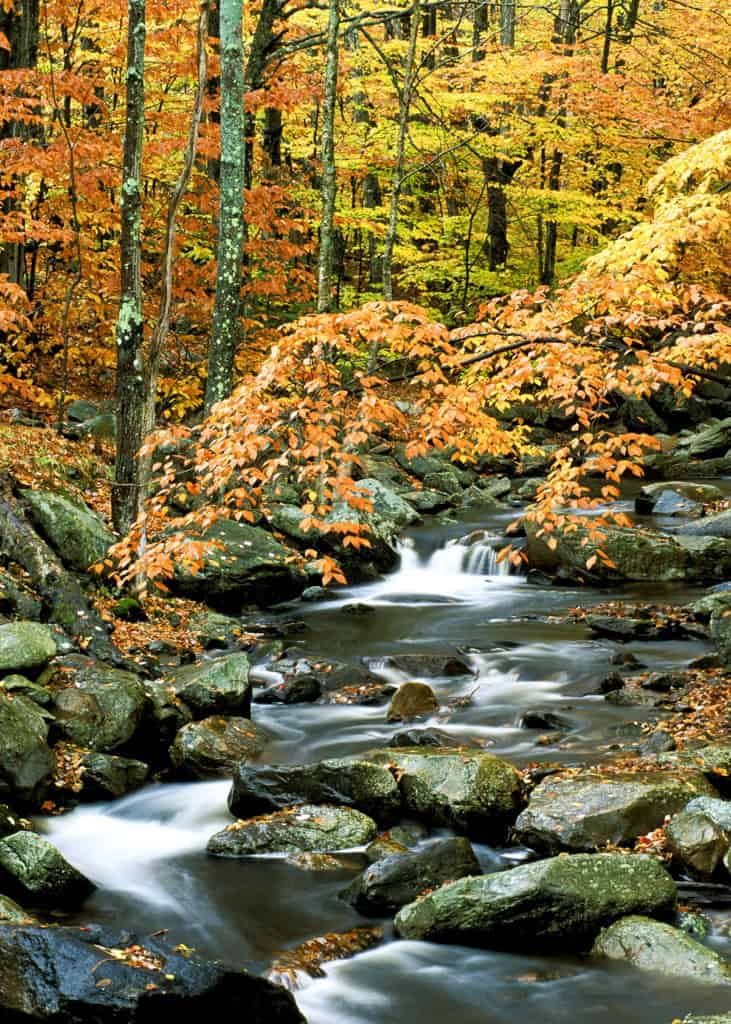
Tis that time of the year again, a favorite time of year for all photographers, when the forests across the country conspire to put on a fireworks show of colors. From red and yellow vine maples of the far west to the gold and orange aspens in the Rockies to the red, yellow, orange, amber, purple and rusts of the east, October and November are a magnificent time of the year to be out taking pictures. But don’t go out any old time and just point your camera at some color and push the shutter- there are some tricks to getting the best pictures. Here are my two favorite fall color secrets: 1. Go out in the rain or just after a rain and 2. Use a polarizing filter. Rain is the best time to photograph leaves, any kind of leaves. All the dust has been washed off and the leaves look fresh and strong. Don’t go out in a downpour and then write me to say how I have caused you to ruin your camera- there is no reason to photograph in a downpour. But when the rain is light or misty the time is perfect. And remember, when it is lightly raining in the meadow it will hardly be raining in the forest. The trick to getting your best shot is to use a polarizing filter. Yes, I know, polarizers are for blue skies and to take the reflection off water but they also take glare off wet leaves and rocks allowing the true, rich colors to show. Be careful about rain drops on your filter, you’ll have to check before every shot. I have a short lens hood that screws into my polarizer allowing me to adjust the polarizer just turning the hood. I have also used a baseball cap to protect the front of the lens until I am ready to take the picture. You can go out and photograph fall colors on sunny days too- backlit leaves can be very dramatic, just don’t stay inside on a lovely rainy day. You’ll be amazed!
Gotta Read This
It is not very often that I find something so compelling, so beautifully written that I feel it necessary to share on my blog. Brenda Berry just posted a wonderful article about a encounter she had with a little girl while photographing in Tanzania Here is the link: http://bberryphotography.com/2011/09/she-matters-2/ This is a great example of the power of words and images and heart. I hope you enjoy it and are as moved by her words I was.