New England Fall Color update
I have been asked a lot lately about the potential for fall color this year. My answer is the same for everyone- I don’t know! In fact, no one knows for sure no matter how definitive he or she might sound. Here is what I know and can see- We had a bit of a cool spell in mid-September causing some trees to show some color early but now (almost October) it is warm and wet so the progression to full color seems to have stopped or at least slowed. Mountainsides are 95% green in central to southern Vermont but some valley bottoms are bright red (from the early turning red maples). When will the peak color be? Got me! Traditionally the best color is between October 10th – 14th, I have no reason to think differently this year. If you are coming up during the first week of October head to northern Vermont, New Hampshire and Maine. During the second week of October you can go where ever you wish, there should be good color everywhere. Head for the coast of New England during the third week of October and go to New Jersey and Maryland and the Smokies at the end of October. Good Luck!
Makes you Think
This post is going to a bit out of the ordinary, even for me. I want you to go to a very short video at this web address- http://www.youtube.com/watch?v=JOl4vwhwkW8&feature=youtube_gdata_player It is ingenious and simple and so very effective. It doesn’t take much to have a big impact in this world- just the intention to try. That, a soda bottle, some sealant and a square of tin roofing. Amazing.
Polarizer for Fall Colors
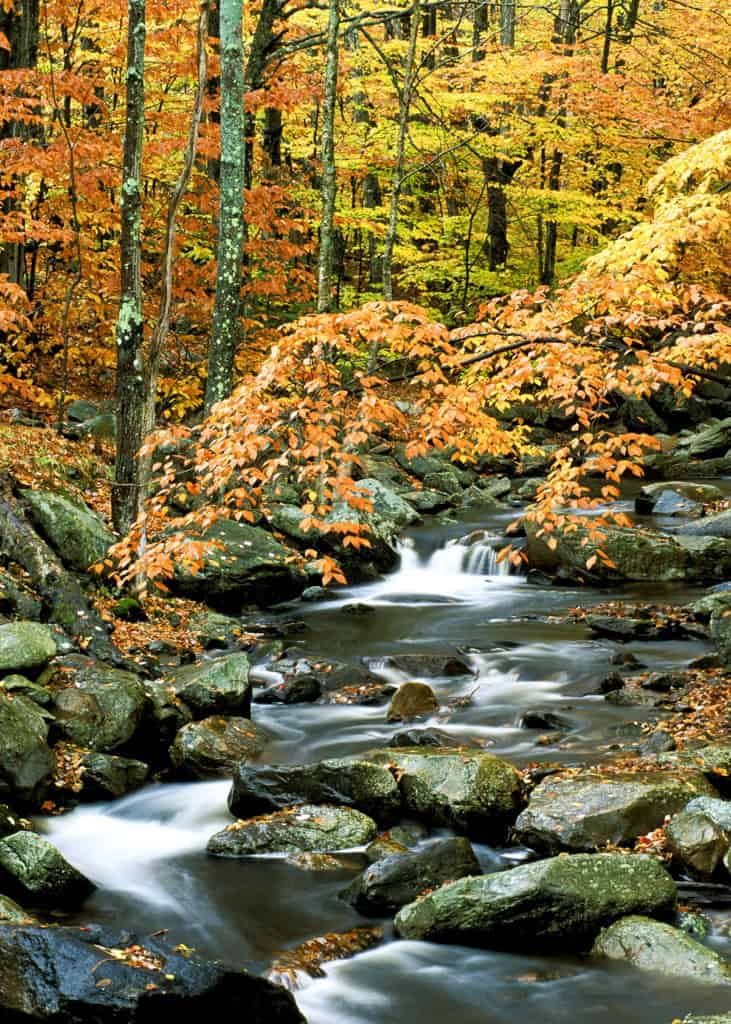
Tis that time of the year again, a favorite time of year for all photographers, when the forests across the country conspire to put on a fireworks show of colors. From red and yellow vine maples of the far west to the gold and orange aspens in the Rockies to the red, yellow, orange, amber, purple and rusts of the east, October and November are a magnificent time of the year to be out taking pictures. But don’t go out any old time and just point your camera at some color and push the shutter- there are some tricks to getting the best pictures. Here are my two favorite fall color secrets: 1. Go out in the rain or just after a rain and 2. Use a polarizing filter. Rain is the best time to photograph leaves, any kind of leaves. All the dust has been washed off and the leaves look fresh and strong. Don’t go out in a downpour and then write me to say how I have caused you to ruin your camera- there is no reason to photograph in a downpour. But when the rain is light or misty the time is perfect. And remember, when it is lightly raining in the meadow it will hardly be raining in the forest. The trick to getting your best shot is to use a polarizing filter. Yes, I know, polarizers are for blue skies and to take the reflection off water but they also take glare off wet leaves and rocks allowing the true, rich colors to show. Be careful about rain drops on your filter, you’ll have to check before every shot. I have a short lens hood that screws into my polarizer allowing me to adjust the polarizer just turning the hood. I have also used a baseball cap to protect the front of the lens until I am ready to take the picture. You can go out and photograph fall colors on sunny days too- backlit leaves can be very dramatic, just don’t stay inside on a lovely rainy day. You’ll be amazed!
Gotta Read This
It is not very often that I find something so compelling, so beautifully written that I feel it necessary to share on my blog. Brenda Berry just posted a wonderful article about a encounter she had with a little girl while photographing in Tanzania Here is the link: http://bberryphotography.com/2011/09/she-matters-2/ This is a great example of the power of words and images and heart. I hope you enjoy it and are as moved by her words I was.
Foreground-again

I’m back on one of my favorite topics- foreground. But this time I’m not going to write so much about the value of foreground ( adds drama, impact, balance to your photography) but more on getting close and really emphasizing the foreground. This is one of the most common mistakes that I notice in landscape photography- yes there is foreground but the photographer is not close again. Let me show you some examples- Here is the scene- Boothbay Harbor, Maine, late afternoon. I’m on a bridge with colorful kayaks on a float below me. Yes the kayaks are foreground and they add some nice color to the shot but the foreground is not compelling, there is no impact. Solution? Get closer! Much better! There is a feeling of being right there on the float. I call these types of pictures participatory images because it looks and feels like the viewer could participate in the scene. To get this look you have to use a wide angle lens (18mm – 24mm is best), a very small f-stop (f16 or f22) and you have to tilt your camera down toward the foreground. When you point your camera down you will notice that the foreground is drawn in toward the camera and the background rises in the viewfinder. The effect is that the image appears to start right at the feet of the photographer and go for miles. Now this is impact! See how you get the feeling of almost sitting on the kayaks? The trick is to take the extra effort and move in really close. It’s not always the case but often, the closer you get to the foreground the better the photograph is going to be. So next time you are photographing a scene that includes foreground take your normal shot and then stop and move in even closer. I think you will find that your pictures will improve.
Story and Advice- No Charge
Ok, ok, ok- one funny heart attack story but that’s it! 7am and I am in the cardiac operating room in Corvallis, Oregon, lying on my back, the cardiac surgeon standing at my side looking at various monitors. I think he may be trying to get a clear picture on ESPN but I can’t be sure. His nurse is at my feet removing my socks and any remaining dignity I might have come in with. The Doctor leans over me and says, “Hello, Mr. Middleton, my name is Dr. Plavof but you may call me Victor if you like. How do you feel?” “Hello, Doctor. I have felt better. You don’t sound like you’re from these parts. Wait, don’t tell me- Slovakia?” (Ok, it wasn’t a great guess but I was having a heart attack so give me a break.) “No, I was born and raised in Russia. Now be sure to lie still for a moment.” “Ok. Your English is not bad.” “I’m still learning… English, that is.” The nurse comes up to my head and leans in saying, “What would you like to be called?” A bit confused with her question but not willing to miss an opportunity, I say, “Your Honor.” “Ok,” she says chortling, “Your honor, you’ll be feeling better soon.” Speed ahead a few hours to my room in the cardiac repair and tire change ward. My nurse, Peter, comes in to check on me and we continue a running conversation. “I thought you said you were a photographer?” Peter says to me a confused look on his face. “I am a photographer, at least I was when I came in here this morning.” “Huh, everyone on the floor thinks you are a judge!” “A judge!?! Do I look like a judge? Do you see any bearing? Do I look like I have wisdom and good judgement?” “Not in that robe and gown, you don’t. But that’s why I am asking. They all say you are a judge!” “Oh, wait a minute. I might have said something in the OR but I can’t be held responsible.” “I understand, you were having a heart attack. But don’t say a thing to anyone. You are getting all your meals first and all the Techs come here first too. I’ve never seen anything like it.” “Huh, I should probably tell Dr. Plavof. I don’t want him thinking I am something I’m not” “Yes you do, your Honor. Unless, that is, you don’t mind waiting longer and eating last!” “Your Honor it is!” So next time you are on an operating table and a nurse asks you what you would like to be called say ‘your honor’ and hope for someone in the room to be less than fluent in English. No bearing necessary, no judgement required, confirmation optional. But meals first, now that’s something!
Vermont Update
I have been getting a lot of questions about how Vermont is going to be this fall. People are contacting me asking what effect tropical storm Irene will have on the October photography season. My answer is: none, the storm will have no lasting effect what so ever. The odd thing about Irene was that in Vermont there was almost no wind so the forests, meadows, mountainsides, vistas are all in great shape and look as they should. Of all the quaint towns, beautiful streams and wonderful covered bridges in the state there are a very few that have been effected. By October I expect all the roads you might travel will all be long open as will every inn and restaurant. As far as the color goes, who knows? It is much too early to predict what kind of fall color season we are going to have. I can say that it has been a great growing season here in New England so that means…I don’t know! Who does? The point is that the Irene won’t have any effect on your photography. That also means that if things don’t work out you can’t blame her, or it, or she, or that or…never mind. Don’t change your plans and don’t listen to the news anymore, just come to Vermont and have a great time!
So I’ve been thinking…

So I’ve been thinking, which usually means that I have been thinking odd thoughts. I’ve been thinking about the role collaborators have played in my career and how I have greatly benefited from them. Over the last 25 plus years I have collaborated on major projects with John Shaw, Wayne Lynch, Bill Fortney, Bruce Morrison, Rod Barbee, Jeff Wendorff, Scott Rouse, Scott Graber and Brenda Berry. Everyone of these people has greatly enhanced the project I was working on and has greatly furthered my career. A good collaborator encourages, cajoles, critiques, questions and, if needed, berates to get the absolute best out of you. And in my case, they also keep me in chocolate, running shoes and crosswords. Of course occasionally, they also give me a heart attack but, really, its a small price to pay for a great project. So you are thinking, what has this got to do with me? Remember, a collaborator is just a fancy name for a photo buddy. Not just a friend but someone who thinks the way you do and appreciates the things you do. The difference between a collaborator and a photo buddy is that there is a common purpose involved, in other words, a project. And the difference between having a project or a purpose to your photography and just going out and shooting random images is the difference between fine chocolate and a rich mud. So go out and either find a photo buddy or acknowledge your photo buddy and then think of something you both can work on. A calendar? A book of seasons? Working portraits? Colors of your area? Hidden places? A photographer’s guide? It doesn’t matter what you choose, just choose something. As soon as you do you will realize the benefits of working closely with another photographer and then you will soon also realize the joys of working together. Oh, and your photography will great improve. So, tell me, why are you photographing all by yourself?